A marketer walks up to the bosses like this and complains: 'We have a bad logo. We can't do good marketing with a logo like this.' And they try to win over the management to change it. You can hear the same from an agency or a hired graphic designer. They come to your company and say more or less openly: 'With that horrible logo of yours, everything will look bad...' If your company needs help with communication, it won't get it from these preachers. We've experienced it many times.
Note: It's true that a number of companies really don't have a good logo, but more on that some other time.
The logo overestimated and underestimated
Some marketers — and many designers — attribute greater significance to a logo than it actually has. They embark on changing it with exaggerated expectations that it will bring an improvement to the company's overall image and thus better business. People say so, but even the best logo simply does not possess such great power.
First, a logo always operates in the context of other things – typography, visual elements, key messages. Second, a logo is almost never the reason for an action or a purchase. The role of a logo and the entire visual identity in your business can be symbolically compared to a salesman's clothing. Great clothing alone does not guarantee a deal, but a bizarre appearance can ruin an otherwise good salesman.
The opposite extreme is represented by logo nihilists. Entrepreneurs who know this truth — and citing it, neglect the external image of their companies. 'Don't fuss with it too much, just let it look a bit decent.' We encounter this in cases where business relies on strong personal connections or exact expertise. Such companies limit investment in communication and visual style as much as they can. However, there is a risk that they take it too far and a malnourished appearance begins to undermine the company. For instance, when personal connections break or a more mature competitor appears.
Beloved rebranding
One of the causes of logo fetishism (let's operationally define it as a pathological overestimation of a logo's importance) is the great popularity of so-called rebranding, which is a fancier name used by marketers and creatives for a redesign.
Why is rebranding so popular?
Firstly, because its result is immediately visible. In a large company, VERY visible. And for actions with immediate visibility — even with uncertain returns — marketers easily secure the necessary budget.
And secondly, rebranding is easy. Just announce a 'tender'! The brief can be knocked out in a few paragraphs – it doesn't really matter that it is full of clichés like 'we want a clean, dynamic, modern logo expressing the company's values.' Suppliers will handle it somehow, something will come out of them, and they won't resist. Agencies and designers love logos, after all. They look good in their portfolios and enjoy extraordinary prestige.
Replacing a logo costs a larger company on the order of millions. Is the ratio between costs and benefits dismal? You're out of luck, because the responsible marketer, already with the aura of a highly capable guru, is perpetrating a rebranding in another unfortunate company and won't help you deal with the consequences.
The company is 'repainted,' but otherwise nothing has changed.
The company has a new logo and can produce a lot of promotional items. They are in the manual, after all! It produces t-shirts, bags, business cards, a Word template, and the website header is replaced... Otherwise, however, everything is somehow the same old story. The salespeople are annoyed because marketing isn't helping them. Because they have nothing in hand to help them explain WHY your products or company are worth the customer's attention.
So what place does a logo belong to in brand communication?
We've already said that a beautiful logo won't save a lousy presentation, let alone a lousy product. The same applies vice versa. A lousy logo degrades a great product and presentation.
OK, so what is the logo supposed to do? How should it work?
First of all - a logo is meant to identify. That is its main function. Furthermore, it should differentiate (your company, product, service from others). And sometimes also classify (your company, product, service into the company it wants to keep). But on its own, it shouldn't explain or sell. That is what the entire (marketing) communication is for.
Keep in mind that a logo represents only a small part of a company's overall communication
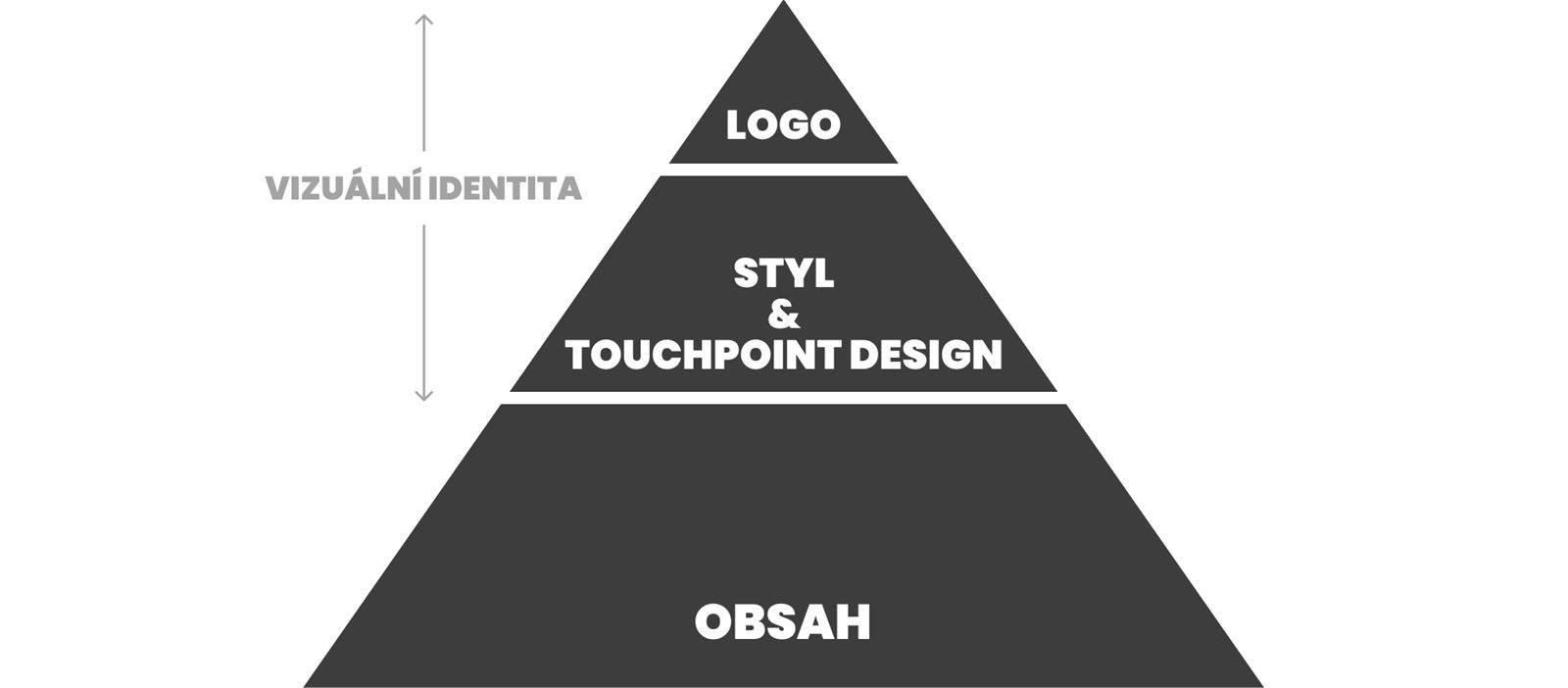
Within a company's communication, a logo is an important but small component (see the pyramid). And it is unwise to dedicate so much attention and resources to the logo that not enough is left for those other tiers, without which the logo is useless. Keep this in mind, especially when you are at the beginning.